



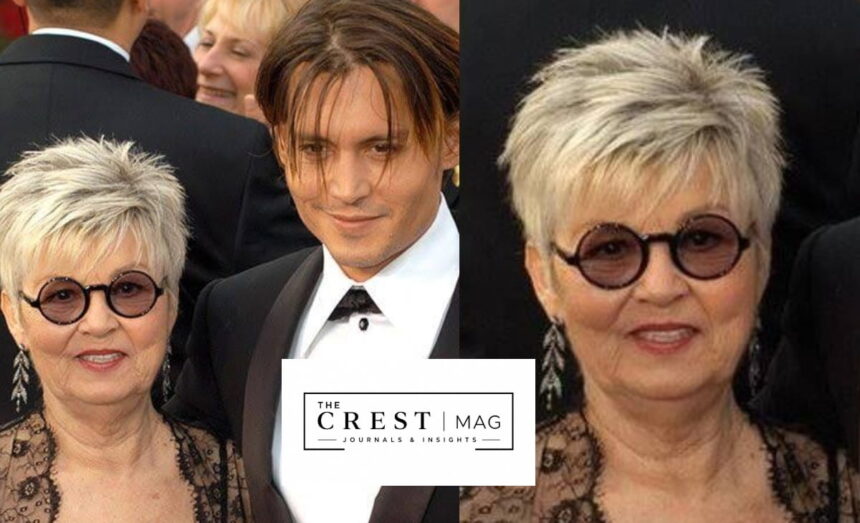
Few people shaped a Hollywood legend as profoundly — and as quietly — as Betty Sue Palmer. The world knows her mainly through her son, Johnny Depp. Yet Betty Sue lived a life that was deeply private, remarkably consequential, and full of raw human complexity. Her journey took her from the Appalachian hills of Kentucky to the gleaming red carpets of Hollywood. Along the way, hardship, resilience, and an enduring — if complicated — bond with her famous son defined her story.
To truly understand Johnny Depp — his intensity on screen, his guarded vulnerability in interviews, his fierce devotion to his own children — one must first understand Betty Sue Palmer.
Early Life: Roots in Rural Kentucky
Betty Sue Palmer entered the world as Elizabeth Sue Wells on January 1, 1935, in Floyd County, Kentucky. Her parents, Walter Everett Wells and Bessie Whitaker Wells, raised her alongside several siblings in the rugged Appalachian countryside. Life in rural Kentucky during the 1930s and 1940s offered little comfort. Coal country culture, tight-knit communities, and economic scarcity defined those years. Betty Sue grew up right in the middle of it all.
Her childhood brought real hardship. Reports describe a turbulent home environment from early on — instability that would later cast a long shadow over her own parenting. Poor resources and limited options surrounded her daily. She did not choose resilience. Life forged it into her.
A Working Woman From the Start
Even as a young woman, Betty Sue showed drive and determination. She entered the workforce early, working most notably as a waitress — a job she held for many years while raising her children. The work was demanding and unglamorous. She performed it anyway, with the same steely focus that seemed to run through everything she did.
That work ethic stuck with her. It would later become one of the qualities her son Johnny admired most, even as other aspects of her behavior left lasting scars.
Marriage, Family, and the Birth of Johnny Depp
In the early 1950s, Betty Sue Wells married John Christopher Depp Sr., a civil engineer. Together they had four children: Daniel P. “Danny” Depp, Deborah Johniene “Debbie” Depp, Elisa Christie Depp (later Dembrowski), and John Christopher “Johnny” Depp II, born June 9, 1963, in Owensboro, Kentucky. Johnny arrived last — the youngest of the four.
A Family Always on the Move
The Depp family rarely stayed in one place. They moved more than twenty times during Johnny’s childhood, chasing work and a vision of stability that always seemed just out of reach. By the time Johnny turned seven, the family had settled in Miramar, Florida. The constant relocation left marks. New schools, new neighborhoods, new faces — but always the same tensions inside the home.
Betty Sue worked hard through all of it. She served tables and managed the household, holding the family together under enormous strain. Johnny later spoke with visible admiration about watching her “work her fingers to the bone.” That image of a woman pushing through exhaustion with stubborn determination clearly stayed with him.
When the Marriage Ended
The marriage between Betty Sue and John Christopher Depp Sr. collapsed in 1978 — when Johnny was just 15. He described his father as a “kind, quiet, and shy man” who could no longer endure the home environment. Betty Sue later married Robert “Bob” Palmer, a man Johnny regarded warmly and described as a stabilizing presence. Bob Palmer passed away in 2000.
A Turbulent Household: The Complex Legacy of Her Parenting
The most publicly discussed aspect of Betty Sue Palmer’s life centers on her parenting. During Johnny Depp’s 2022 defamation trial against Amber Heard, sworn testimony pulled back the curtain on his childhood. What the world heard shocked many longtime admirers.
What Depp Said in Court
Depp described a home shaped by volatility, fear, and physical abuse. Everyday objects became weapons — an ashtray across a room, a belt, a shoe, a telephone. His siblings corroborated these accounts. His sister Christi Dembrowski called their mother “volatile,” “unstable,” and abusive toward both the children and their father.
In a 2025 interview with The Telegraph, Depp reflected on the abuse directly. He said his mother had beaten him with a stick, a shoe, an ashtray, and a phone. Yet he added something unexpected: “I thank her for that. She taught me how not to raise kids. Just do the exact opposite of what she did.”
The Cycle Behind the Behavior
Depp did not frame his mother purely as a villain. He recognized that her own childhood carried trauma — that cycles of instability pass between generations in ways that resist simple blame. His testimony showed a man trying to hold both truths at once: real harm caused, and the human context behind it.
That nuance shaped his entire approach to fatherhood. When his partner Vanessa Paradis became pregnant, Depp said he already knew exactly what kind of father to be. “Do the opposite of what Betty Sue did,” he stated plainly. He refused to raise his voice around his children. He wanted to show them options — not fear.
The Mother-Son Bond: Complexity, Loyalty, and Love
The most striking thing about the relationship between Betty Sue Palmer and Johnny Depp is not its darkness — it is its endurance. Despite everything, Depp stayed devoted to his mother throughout her life. The bond shifted over the decades, moving from the fear of childhood into something more like a complicated adult love.
The Farm, the Tattoo, and the Walk of Fame
When Depp began earning real money as an actor, one of his first major gestures pointed straight back to his mother. He purchased a 43-acre horse farm in Kentucky for her — at a cost of nearly one million dollars. It fulfilled a promise he had made long before fame arrived. He had watched her struggle for years. The moment he could lift that burden, he did.
He wore her name on his body, too. A heart tattoo on his left arm reads “Betty Sue” — a permanent mark of connection that outlasted the complexity of their history.
Betty Sue also appeared at the biggest moments of her son’s professional life. She stood beside him when he received his star on the Hollywood Walk of Fame. She attended the 76th Annual Academy Awards in 2004 as his guest, standing proudly next to him and Vanessa Paradis. These moments say something clear: this was not a son who had cut his mother off. It was a son who, despite the wounds, kept choosing her.
Later Years, Illness, and Death
The Final Chapter
Age brought serious health challenges for Betty Sue. Cancer took hold in her later years, and she needed regular medical care. Depp spared no expense. He covered the cost of her treatment and visited her frequently in hospital. Those close to the family described him as deeply attentive throughout her decline.
Even as his marriage to Amber Heard fell apart in 2016 — one of the most turbulent periods of his adult life — Betty Sue stayed a central concern. Sources close to Heard even noted that the actress visited Betty Sue regularly in hospital during that period.
Her Passing
Betty Sue Palmer died on May 20, 2016, in Los Angeles, California. She was 81 years old. Her family held a private memorial service on June 29th in Los Angeles. She left behind four children, eight grandchildren, and one great-grandchild.
Her death arrived during a painful chapter of Johnny Depp’s life — days before his public split from Amber Heard became international news. Grief and chaos converged. For Depp, losing his mother meant losing the person who, for better or worse, had shaped him more than anyone else.
Her Lasting Influence on Johnny Depp
Betty Sue Palmer touched every corner of her son’s identity. The guitar she bought him at age 12 ignited a passion for music that opened the door to his entire career. The instability of childhood gave him an empathy for outsiders and misfits — qualities that powered the most beloved characters he ever played, from Edward Scissorhands to Captain Jack Sparrow.
Her parenting style, painful as it was, gave him a clear blueprint — not of what to do, but of what never to do. He raised his children, Lily-Rose and Jack, in France, largely away from Hollywood’s spotlight, in an environment built on calm and choice.
Betty Sue was a woman of contradictions. Tough and funny, mean and loving, all at once. A product of a hard Appalachian upbringing, she passed on both wounds and gifts. She worked herself ragged for decades to keep her family alive. She also created a home that her son later described, under oath, as defined by fear. Both things are true.
A Private Woman in a Public World
What stands out most about Betty Sue Palmer is how completely she avoided the public eye. Unlike many celebrity parents, she never gave interviews. She never sought attention. She never used Johnny’s fame to build a platform of her own. The public record of her life stays thin — a reflection of a woman who lived on her own terms, away from cameras and comment.
Most of what the world knows about her came through her son’s words. A handful of photographs captured her at Hollywood events, standing close beside him. Memory preserves her largely as a figure in someone else’s story.
But Betty Sue Palmer was far more than a footnote. She grew up in poverty, worked through decades of difficulty, made serious mistakes, and still managed to raise the children who surrounded her at the end. Her story holds the kind of genuine human complexity that hides behind even the most glamorous surfaces of celebrity life. She deserves to be remembered not only as the mother who shaped a movie star — but as a woman whose own life was real, difficult, and worthy of notice.
Conclusion
Betty Sue Palmer’s life resists easy summary. She came from poverty in rural Kentucky, moved through instability and multiple marriages, worked without stopping, and watched her youngest child capture the world’s attention. Her relationship with Johnny Depp carried pain and love, damage and devotion, wounds that lasted a lifetime alongside a bond that endured anyway.
What her son chose to do with the legacy she left him — turning suffering into purpose, choosing gentleness over repetition, honoring her even while staying honest about her failures — stands as the most fitting tribute to who she was. Betty Sue Palmer never sought the world’s attention. But she shaped someone who captured it completely. That, in its own way, is a lasting legacy.
For more insights, read this related post: Jay Tucker: The Quiet Engineer Who Married — Then Left — Hollywood Behind
Frequently Asked Questions
Who was Betty Sue Palmer?
Betty Sue Palmer, born Elizabeth Sue Wells on January 1, 1935, in Floyd County, Kentucky, was the mother of Hollywood actor Johnny Depp. She worked as a waitress for most of her life and raised four children largely on her own after her divorce from John Christopher Depp Sr.
When and how did Betty Sue Palmer die?
Betty Sue Palmer died on May 20, 2016, in Los Angeles, California, at the age of 81. Cancer took her life after a lengthy illness. Her family held a private memorial service on June 29, 2016, in Los Angeles.
What was Betty Sue Palmer’s relationship with Johnny Depp like?
Their relationship was complex. Depp has spoken openly about abuse he experienced during childhood. At the same time, he remained deeply loyal to her throughout her life — buying her a horse farm, having her name tattooed on his arm, and bringing her to major Hollywood events. He later forgave her, crediting her failures with teaching him exactly how to be a better parent.
Did Johnny Depp financially support Betty Sue Palmer?
Yes. After achieving success in Hollywood, Depp purchased a 43-acre horse farm in Kentucky for his mother at a cost of nearly one million dollars. He also covered her medical expenses during her final illness and made sure she never needed to work again.
How many children did Betty Sue Palmer have?
Betty Sue had four children. From her first marriage to John Christopher Depp Sr., she had Danny Depp and Debbie Depp. From her second marriage, she had Christi Dembrowski and Johnny Depp. She also had eight grandchildren and one great-grandchild at the time of her death.