



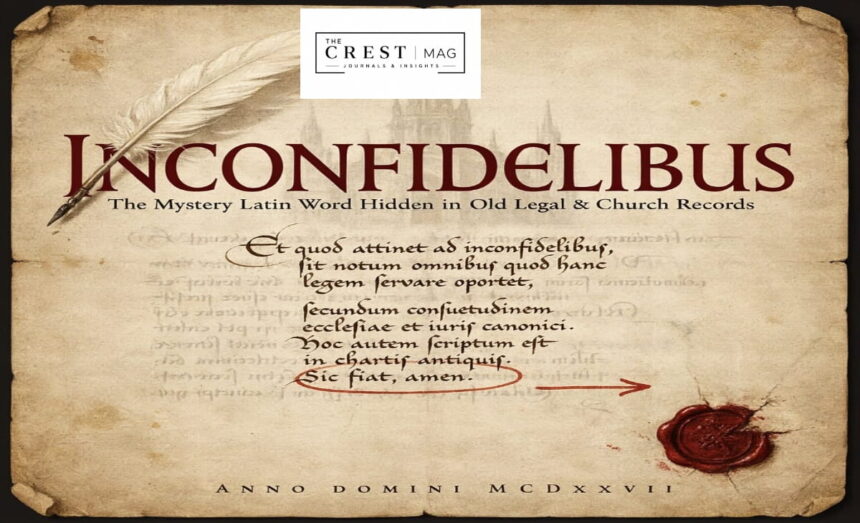
Every so often, a strange word surfaces online. It doesn’t appear in any English dictionary. Classical Latin lexicons don’t list it either. Yet it has a familiar shape — the shape of old legal or church Latin. Incfidelibus is one of these words.
Let’s be upfront about one thing first. This term has no single, agreed-upon definition in mainstream reference works. What follows is a careful linguistic investigation. We’ll break the word into its parts, compare it to known relatives, and look at where similar phrases show up in real documents.
Quick Facts Table
| Aspect | Details |
| Likely original form | “In fidelibus” |
| Root word | Fidelis (Latin for “faithful”) |
| Word family | Fides, fidelitas, confido, infidelis |
| Literal meaning | “Among the faithful” or “with respect to the faithful” |
| Common historical contexts | Canon law, notarial deeds, ecclesiastical records |
| Likely cause of the odd spelling | OCR error, manuscript transcription drift, or typo |
| Standard dictionary entry? | No — not documented under this exact spelling |
| Best way to confirm meaning | Trace back to the original source document |
Breaking Down the Word
The word splits into two recognizable pieces:
- “In” — a common Latin preposition. It means “in,” “among,” “into,” or “with,” depending on context.
- “Fidelibus” — the dative or ablative plural of fidelis. This adjective means “faithful,” “loyal,” or “trustworthy.” It’s the same root behind English words like “fidelity,” “confide,” and “infidel.” You’ll also recognize it from “Semper Fidelis,” the U.S. Marine Corps motto.
Put together, “in fidelibus” likely translates to “among the faithful” or “with respect to the faithful ones.” That extra “c” in “incfidelibus” probably crept in through a scanning error. Old manuscripts get digitized by OCR software, and that software often misreads faded ink or unusual letterforms. A modern typo could explain it too. Once a misspelling gets indexed by search engines, it spreads fast — long after anyone traces it back to the source.
The Root Word: Fidelis and Its Family
The broader word family built on fides (faith, trust) helps explain where “incfidelibus” probably comes from:
- Fides — faith, trust, or credit. This is the root of the whole family.
- Fidelis — faithful, loyal, reliable. People used it to describe a trustworthy servant, soldier, or follower.
- Fideles — the plural form. Christian liturgical texts and canon law use it to mean “the faithful,” or members of a congregation.
- Fidelitas — fidelity, the quality of being faithful.
- Confido / Confidere — to trust fully. This gives us “confide” and “confidence.”
- Infidelis — unfaithful or disbelieving. This gives us “infidel.”
“Fidelibus” is simply the plural form of “fidelis” in the dative or ablative case. Latin uses these cases in phrases like “to the faithful” or “among the faithful.”
Where Similar Phrases Appear
Formal Latin often pairs a preposition with a dative or ablative plural noun. You’ll spot this pattern in a few specific places.
Church and Canon Law Records
Catholic canon law uses “fideles” constantly. The term refers to baptized Church members. Papal bulls, diocesan letters, and canonical texts often direct instructions toward “the faithful.” A phrase like “in fidelibus” fits naturally here. It could describe something done among or for church members — pastoral care, discipline, or instruction.
Civil and Notarial Law
Some legal systems keep strong Roman law roots. Louisiana’s civil law tradition and several European civil codes still use Latin phrases in notarial documents. Oaths, fiduciary appointments, and sworn certifications often lean on words rooted in fidelis. The language emphasizes trust and reliability in the role being certified.
Historical and Academic Documents
Old manuscripts often contain Latin phrases that get slightly altered during digitization. Historians and genealogists run into this constantly. Medieval charters, guild records, and church registries sometimes hide a slightly garbled phrase — like our hypothesized shift from “in fidelibus” to “incfidelibus.”
Why the Exact Meaning Stays Elusive
Let’s stay honest about the limits here. We don’t have a specific, traceable source — no manuscript, no legal filing, no dictionary entry. That means we can’t confirm a few things:
- Whether “incfidelibus” is a genuine historical term, or just a modern typo that spread online.
- Which document, tradition, or jurisdiction it might trace back to, if it’s authentic.
- Whether “in fidelibus” was the intended phrase at all. It might be a name, a place, or something else entirely.
This kind of uncertainty happens often with rare search terms. Many words online look meaningful because they resemble known roots. But they don’t always trace back to a single documented source. Good research means admitting that gap instead of inventing a confident-sounding but shaky definition.
How to Investigate This Term Further
Anyone who runs into “incfidelibus” — in an old document, a genealogical record, or a search query — can take a few practical steps.
- Check the original source document. Go back to the scanned image or manuscript itself. This often reveals whether the word is really two words squeezed together, a misread letter, or a genuinely unusual spelling.
- Consult a Latin dictionary. Lewis and Short’s A Latin Dictionary and the Dictionary of Medieval Latin can confirm whether related phrases exist in documented usage.
- Study the surrounding context. A word in a notarial deed likely means something different than the same word in a theological text. Context usually offers the best clue.
- Look for OCR errors. Archives digitize handwritten and printed documents using automated character recognition. These systems frequently misread old ligatures and abbreviations, producing garbled results.
- Cross-reference known Latin formulas. Phrases like “in fide,” “de fidelitate,” “fidelium,” and “pro fidelibus” show up in documented legal and liturgical contexts. Comparing “incfidelibus” against this family can help narrow down its likely origin.
The Broader Lesson: Language, Trust, and Fidelity
Set the specific uncertainty aside for a moment. The root concept — fidelis, faithfulness — still carries weight across law, religion, and everyday language. Oaths of office lean on it. Marriage vows lean on it. Religious commitments and professional codes of conduct lean on it too. Words like “fiduciary,” “confidence,” “fidelity,” and “infidelity” all trace back to this Latin root. Humans have built trust into their institutions this way for thousands of years.
Whether “incfidelibus” turns out to be a real historical phrase or a modern typo, its parts point toward that same deep well of meaning: faith, trust, loyalty, and the bonds that those ideas have historically enforced.
Conclusion
“Incfidelibus” doesn’t have a settled, dictionary-confirmed definition. Treat any article that claims otherwise with skepticism. We can say this much with confidence: it closely resembles “in fidelibus,” rooted in fidelis (faithful). Phrases shaped this way have historically appeared in church, legal, and notarial Latin. If you’re researching this term in a specific document, trace it back to the source. Check specialized Latin dictionaries. Pay close attention to the surrounding material — context reveals more than the isolated word ever will.
You may also like this content: fascisterne Explained: How a Broken Nation Bred Europe’s Darkest Ideology
FAQs
What does “incfidelibus” mean?
No dictionary confirms an exact meaning. It most likely comes from “in fidelibus,” a Latin phrase meaning “among the faithful” or “with respect to the faithful ones.”
Is “incfidelibus” a real Latin word?
Not in this exact spelling. Classical and medieval Latin dictionaries don’t list it. It probably comes from a transcription error, an OCR misread, or a typo of “in fidelibus.”
Where does the word “fidelibus” come from?
It comes from fidelis, the Latin word for “faithful” or “loyal.” “Fidelibus” is the dative or ablative plural form, used in phrases like “to the faithful” or “among the faithful.”
Why do old documents contain garbled Latin phrases like this?
Many historical manuscripts get digitized using OCR software. This software often misreads faded ink, unusual letterforms, or ligatures common in old handwriting, which produces spelling errors like “incfidelibus.”
How can I find the real meaning of a term like this in my own document?
Go back to the original source and compare it against the scanned image. Cross-reference it with a Latin dictionary, and study the surrounding text for context clues about its intended meaning.