



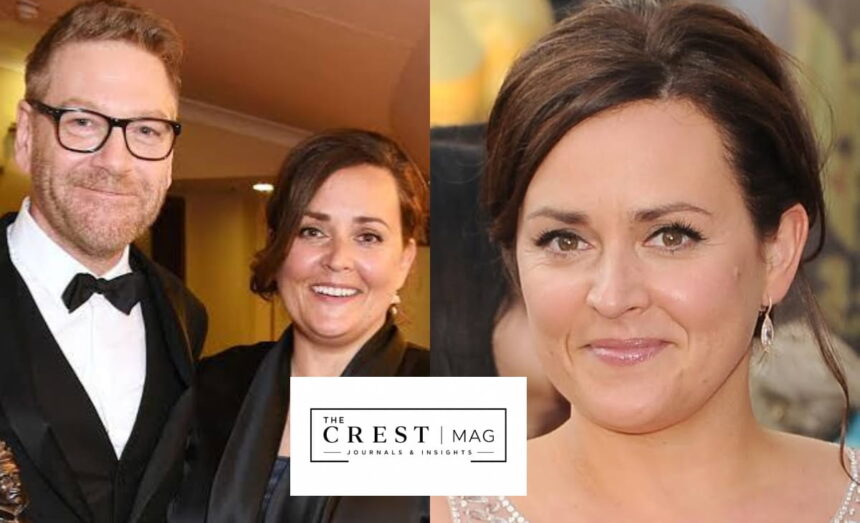
In an industry that relentlessly manufactures celebrity, Lindsay Brunnock stands as a quiet anomaly. She was born in 1970 in Cambridgeshire, England, and built a respected career as a film art director. She then stepped away from professional credits — not out of failure, but by deliberate choice. Today, the general public knows her mainly as the wife of Sir Kenneth Branagh, the celebrated Irish-British actor, director, and producer. Reducing her to that single identity, however, misses the fuller picture of a woman whose professional accomplishments are genuinely noteworthy.
This is the story of Lindsay Brunnock: the artist, the professional, the partner, and the person who decided — on her own terms — that a life lived quietly can be just as meaningful as one lived loudly.
Early Life and Origins
Lindsay Antonia Brunnock was born on April 5, 1970, under the sign of Aries, in Cambridgeshire, England. The region is famously home to one of the world’s greatest universities. Its landscape is defined by flat fens, river waterways, and market towns. This setting provided an unlikely but formative backdrop for someone who would go on to shape the visual environments of British cinema.
A Wealthy and Supportive Family
Her parents, James Brunnock and Margaret Brunnock, provided a comfortable and stable upbringing. James was a successful businessman, and the family had the financial security to give Lindsay both opportunity and exposure. From a young age, she was captivated by art and cinema. She reportedly travelled all the way to London just to look at film posters and watch movies on the big screen. That dedication, even as a child, speaks to genuine creative hunger rather than a passing hobby.
The family later sold their Cambridgeshire home and relocated to the Dordogne region of France. This move added an international dimension to Lindsay’s formative years, even though she had already set her sights firmly on a career in British film.
Education and Early Artistic Inclination
After completing her secondary education, Lindsay pursued higher education with a focus on arts and design. The specifics of her university years remain private. This is consistent with how she has handled virtually all personal information throughout her life. The results of that education, however, are clear in the precision and craft she later brought to her screen productions.
Entering the Film Industry
Lindsay Brunnock entered the British film and television industry in 1996. She started as an assistant designer — a role that demands patience and a sharp eye for detail. Her first project was the acclaimed BBC mini-series The Tenant of Wildfell Hall, an adaptation of Anne Brontë’s novel that critics and audiences warmly received. That same year, she worked as designer on the TV movie The Moonstone, another literary adaptation. From the outset, she showed a natural affinity for period visuals and production design.
What an Art Director Actually Does
Art direction in film is a discipline that rarely receives the glamour of acting or directing, yet it underpins every scene the audience experiences. An art director is responsible for the overall visual look of a production — the sets, the props, the spatial design, and the aesthetic coherence of everything the camera sees. The role demands both creative vision and precise logistics. Lindsay Brunnock proved herself adept at both from early in her career.
Rising Through the Ranks
Promotion to assistant art director came quickly, and her portfolio began to expand. In 1997, she worked on A Merry War (also known as Keep the Aspidistra Flying), the adaptation of George Orwell’s novel. During this production, she reportedly encountered Kenneth Branagh for the first time. At that point, their connection was limited to a brief professional introduction. The actress Helena Bonham Carter, who was Branagh’s girlfriend at the time, facilitated the meeting. Lindsay was reportedly struck by Branagh immediately but maintained professional distance out of characteristic restraint.
Her career continued to grow through the late 1990s. Credits on The Governess (1998) and This Year’s Love (1999) followed. This Year’s Love — a romantic drama set in Camden Town and directed by David Kane — gave her experience with contemporary urban aesthetics, adding versatility to a growing body of period work.
The Peak of Her Professional Career
By 2000, Lindsay Brunnock was working on increasingly prominent productions. That year, she contributed to Born Romantic, a charming ensemble British film set largely in a salsa club. The film required the kind of intimate visual texture that good art direction delivers almost invisibly — and Lindsay was becoming exactly the professional who could deliver it.
The Abduction Club and Critical Recognition
The year 2002 marked a significant step forward on two fronts — professionally and personally. As art director on The Abduction Club, an 18th-century period comedy drama, she earned considerable praise for the production’s design. Period films demand particular rigour from the art department. Historical accuracy must balance with cinematic appeal, and the visual world must feel genuinely inhabited rather than constructed. The film’s reception reflected the quality of that work.
Shackleton: Where Career and Romance Converged
Also in 2002, Lindsay worked on Shackleton, the ITV adventure mini-series depicting Ernest Shackleton’s legendary 1914 Antarctic expedition. The production was ambitious in scope and starred Kenneth Branagh in the title role. Working closely together on a demanding shoot, their earlier acquaintance deepened into genuine friendship — and then into something more. By the time filming wrapped, a relationship had quietly begun.
Her Busiest Year: 2003
The year 2003 proved the most professionally intensive of Lindsay’s career. She contributed to four separate productions: the TV movie Loving You, the acclaimed Stephen Fry-directed comedy Bright Young Things — considered her most commercially successful credit — the TV series The Last King, and the drama Ready When You Are, Mr. McGill. Bright Young Things, adapted from Evelyn Waugh’s satirical novel Vile Bodies, gave her work considerable visibility and confirmed she was operating at a high level within British cinema.
Final Credit and a Deliberate Step Back
Her final credited film work arrived in 2006 — assistant art director on Starter for 10, the coming-of-age comedy-drama starring James McAvoy. The film performed well and received strong reviews. After that project, Lindsay Brunnock stepped away from professional film credits entirely. No production has carried her name since. Whether this withdrawal reflected a deliberate lifestyle choice, the demands of her husband’s global career, or a combination of both remains something she has never addressed publicly.
The Relationship with Kenneth Branagh
No account of Lindsay Brunnock’s life would be complete without examining her relationship with Sir Kenneth Branagh. Their partnership is genuinely interesting on its own terms — not simply as a footnote to his fame.
Who Is Kenneth Branagh?
Kenneth Branagh was born in Belfast in 1960. By the time he and Lindsay grew close, he had already lived several very public lives. He attended the Royal Academy of Dramatic Art, founded the Renaissance Theatre Company, directed critically lauded Shakespearean adaptations, and married actress Emma Thompson in 1989. That marriage — arguably the most glamorous pairing in British cinema of its era — ended in 1995. Branagh’s relationship with Helena Bonham Carter, which followed from 1994, lasted until 1999.
How Lindsay and Kenneth Met
During Branagh’s years with Bonham Carter, Lindsay was introduced to him — in 1997, by Bonham Carter herself. Accounts consistently describe it as a straightforward professional introduction. Lindsay, aware of the dynamic, kept appropriate distance. Their friendship only developed when they worked together on Shackleton in 2002, long after Branagh and Bonham Carter had parted ways.
A Romance That Grew Without Fanfare
Their relationship deepened quietly. They made their first public appearance as a couple at the Gosford Park premiere during the London Film Festival in November 2001, though some sources place the full development of their romance during or after the Shackleton shoot in 2002. By the following year, they were ready to make it permanent.
On May 24, 2003, Kenneth Branagh and Lindsay Brunnock married. The ceremony was small, private, and held away from the British media — specifically in a discreet apartment in New York City. The elopement-style choice suited both of them and set the tone for everything that followed.
A Marriage Built on Quiet Solidarity
More than two decades on, the marriage of Lindsay Brunnock and Kenneth Branagh remains one of the more enduring partnerships in British entertainment. Its strength lies not in celebrity, but in apparent solidity amid an industry famous for instability.
What Friends Say About Lindsay
Friends and acquaintances have consistently described Lindsay as a grounding presence. She is level-headed, mature beyond her years, and privately supportive rather than publicly performative. She visited Branagh on location in Sweden during the final season of the crime drama Wallander. She accompanied him to the 2022 Academy Awards, where Branagh won the Oscar for Best Original Screenplay for Belfast — a deeply personal film about his childhood in Northern Ireland. Observers described the couple’s reaction as a warm and genuine embrace.
A Resolutely Private Life
Lindsay maintains no social media accounts. She gives no interviews. She does not court the press. Yet she appears reliably and warmly at the moments that matter, signalling a partnership that operates entirely on its own terms. The couple has no children — reportedly a deliberate choice they made together. Their life in the English countryside, shared with dogs and shaped by creative interests and mutual respect, reflects the values they have consistently demonstrated across their years together.
The Role of Art Direction in Cinema
To fully appreciate Lindsay Brunnock’s professional legacy, it helps to understand the craft she practised. Art direction is one of cinema’s essential but underappreciated disciplines. The art director works alongside the production designer to realise a film’s visual world — selecting and overseeing sets, sourcing props, ensuring historical consistency, and collaborating across departments from costume to lighting.
Why British Art Directors Must Work Smarter
British cinema typically operates on more modest budgets than Hollywood productions. Art directors must therefore be creative and resourceful in equal measure. They build worlds that feel authentic without the financial cushion that American studios can provide. The period productions Lindsay worked on — from Victorian England in The Tenant of Wildfell Hall to the 18th-century world of The Abduction Club to the Antarctic in Shackleton — all demanded exactly that combination of historical knowledge and practical ingenuity.
The Invisible Achievement
When audiences absorb a story and never think about the sets, the art director has done their job perfectly. Lindsay Brunnock’s work across a decade of British film and television demonstrates that standard of invisible excellence.
Legacy and Significance
Lindsay Brunnock defies the conventions of celebrity biography. She is not famous in the traditional sense. She built a solid career in British film, chose her moment to step back, and has since lived a life that prioritises depth over breadth. In an age of relentless self-promotion, that is a more radical position than it initially appears.
She is also a reminder that the women beside famous men are often far more interesting than the “famous man’s wife” label allows. Lindsay had a career before Kenneth Branagh entered her life. She made creative choices, earned credits, and contributed to productions that stand on their own merits. Her decade-long body of film work deserves recognition independent of whom she married.
Born in Cambridgeshire in 1970, Lindsay Antonia Brunnock built something quiet and real — first a career, then a marriage, then a life. In a world that mistakes loudness for significance, that is no small achievement.
Conclusion
Lindsay Brunnock may not seek the spotlight, but her story rewards those who look for it. She grew up in Cambridgeshire with a childhood passion for cinema, turned that passion into a professional career spanning more than a decade, and built an enduring marriage with one of Britain’s most respected creative talents. Her art direction credits — from The Tenant of Wildfell Hall to Bright Young Things to Starter for 10 — reflect genuine skill in a demanding field. Her choice to step away from professional life and guard her privacy is not a diminishment of her story; it is part of what makes it worth telling. Lindsay Brunnock chose her life with intention. In an industry built on performance, that quiet intentionality stands out more than any headline ever could.
Dive deeper with this related post: Daniel Clifton Pratt: The Blue-Collar Father Who Secretly Shaped Chris Pratt’s Hollywood Success
Frequently Asked Questions
Who is Lindsay Brunnock?
Lindsay Brunnock is a British film art director born on April 5, 1970, in Cambridgeshire, England. She is known professionally for her work on films such as Starter for 10 (2006), Bright Young Things (2003), and The Abduction Club (2002). She is also widely known as the wife of Sir Kenneth Branagh, whom she married in May 2003.
How did Lindsay Brunnock meet Kenneth Branagh?
Lindsay Brunnock first met Kenneth Branagh in 1997, when Helena Bonham Carter — Branagh’s girlfriend at the time — introduced them during the production of A Merry War. Their friendship deepened years later when they worked together on the 2002 ITV mini-series Shackleton, and a romantic relationship developed from there.
When and where did Lindsay Brunnock marry Kenneth Branagh?
Lindsay Brunnock and Kenneth Branagh married on May 24, 2003, in a small and private ceremony held at an apartment in New York City. The couple deliberately kept the event away from the British media, reflecting their shared preference for privacy.
Does Lindsay Brunnock have children?
Lindsay Brunnock and Kenneth Branagh do not have children. Reports indicate the couple made a deliberate decision not to have children, though they have never elaborated publicly on the reasons behind that choice.
What is Lindsay Brunnock’s net worth?
Lindsay Brunnock’s net worth is estimated at approximately $2 million, accumulated through her career as a film art director across various British film and television productions between 1996 and 2006. Her husband, Sir Kenneth Branagh, has a significantly higher estimated net worth of around $60 million, earned through his decades-long career as an actor, director, and producer.