



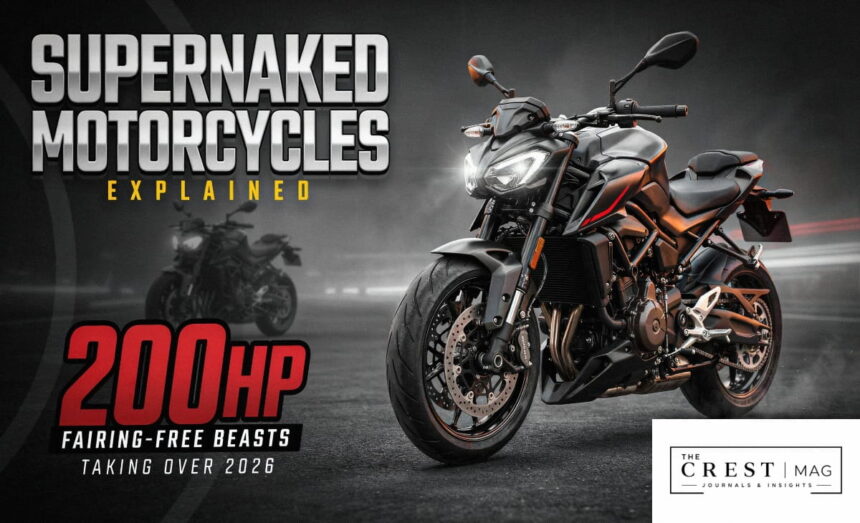
Walk through any supermaked motorcycle dealership today. You’ll spot a category of bikes that looks almost unfinished. No bodywork. Exposed frame tubing. An engine that could power a superbike.
These are super naked motorcycles. Some riders call them hyper nakeds. They are one of the fastest-growing segments in modern motorcycling.
Super nakeds mix raw sportbike power with the upright riding position of a standard bike. The result? A machine that can outrun most things on a twisty road. It can also take you to work on Monday morning without punishing your wrists.
This guide covers what a super naked is, where the category came from, the best models today, and how to pick the right one for you.
Quick Facts: Super Naked Motorcycles at a Glance
| Feature | Details |
| Engine Size | 890cc – 1390cc |
| Power Output | Roughly 150–215 hp |
| Body Style | No fairings, upright riding stance |
| Top 2026 Models | KTM 1390 Super Duke R, Ducati Streetfighter V4, Aprilia Tuono V4, BMW S 1000 R, Kawasaki Z H2, Yamaha MT-10 |
| Best Suited For | Experienced riders who want sportbike power with daily-ride comfort |
| Approx. Starting Price | $15,000–$20,000+ (varies by market and model) |
| Fuel Tank Range | Typically 15–18 liters |
What Exactly Is a Super Naked Motorcycle?
A supermaked is a naked (unfaired) motorcycle built around a big, powerful engine. Most fall between 1,000cc and 1,300cc. A few clever middleweight bikes also compete in this space using smart engineering instead of sheer size.
A standard naked bike might make 70 to 120 horsepower. It’s built to be approachable. A super naked is different. It routinely makes 150 to 215 horsepower. It’s built to be genuinely fast, both in a straight line and through corners.
Key Traits of the Super Naked Class
- Big, powerful engines. Inline-fours, V4s, and V-twins borrowed from race-bred sportbikes, often slightly detuned but still capable of superbike-level numbers.
- No fairings. The bodywork is stripped away. This cuts weight and gives these bikes their aggressive “streetfighter” look.
- Upright ergonomics. Wide handlebars and a relaxed seating position. This makes low-speed control easier and long rides more comfortable than on a sportbike.
- Advanced electronics. These bikes pack serious power with little wind protection. So manufacturers add cornering ABS, multiple ride modes, wheelie control, launch control, and semi-active suspension to keep things manageable.
- Aggressive styling. Sharp bodywork, LED lighting, and minimalist tails give the segment its signature “predator” look.
Where the Super Naked Category Came From
The category traces back to the “streetfighter” scene of the late 1980s in the UK and Europe. Riders who crashed their faired sportbikes often couldn’t afford new bodywork. So they stripped the bikes down and kept riding. A cost-saving fix turned into a full subculture.
Manufacturers took notice. Ducati is often credited with formalizing the class with the Monster in 1993. It was built as a naked bike from the ground up, not just a stripped sportbike. Triumph followed with the Speed Triple soon after.
How “Super” Got Added to Naked
The “super” label took hold in the 2000s and grew through the 2010s. Manufacturers began fitting full-size superbike engines into naked chassis, instead of smaller, detuned units. KTM’s Super Duke R, Ducati’s Streetfighter, Aprilia’s Tuono, and BMW’s S 1000 R pushed the segment toward true superbike-level performance. That’s how “super naked” and “hyper naked” became standard terms in every major manufacturer’s lineup.
supermaked vs. Standard Naked vs. Superbike
Think of naked motorcycles as a spectrum.
Entry-level and middleweight nakeds — like the Yamaha MT-07 or Honda CB650R — focus on approachability and manageable power for new or budget-conscious riders.
Middleweight performance nakeds — like the Yamaha MT-09 or Triumph Street Triple — step up the power and handling, while staying lighter and less intimidating than the flagship class.
Super nakeds sit at the top. These are litre-class (or near-litre-class) bikes with superbike-derived engines and track-ready chassis. Horsepower often rivals or beats dedicated sportbikes, all wrapped in an upright, naked package.
Superbikes, by contrast, keep the full fairing and a forward-leaning, race-focused riding position. A super naked takes that same technology and asks: what if we built this for how people actually ride on the street?
The Best Super Naked Motorcycles Right Now
Nearly every major manufacturer now fields a flagship contender in this space.
KTM 1390 Super Duke R
Long considered the benchmark of the class. It pairs a torque-rich V-twin with sharp handling and a wheelie-happy character. It also offers solid fuel range for a performance naked.
Ducati Streetfighter V4
Built on the same platform as Ducati’s Panigale superbike. It brings a race-derived V4 engine, semi-active suspension, and top-tier electronics. The S and SP variants push even further into track territory.
Aprilia Tuono V4
Uses a MotoGP-derived V4 engine to deliver superbike-rivaling performance. Recent updates have raised displacement and power while sharpening aerodynamics and electronics.
BMW S 1000 R
BMW’s naked take on its S 1000 RR superbike. It has an inline-four engine and a full electronics suite. It leans slightly more toward everyday usability than some rivals.
Kawasaki Z H2
Stands apart thanks to a supercharged inline-four engine. This forced-induction setup delivers a distinctive power surge and a futuristic character.
Yamaha MT-10
Powered by a crossplane-crankshaft inline-four derived from Yamaha’s R1 superbike. Known for balancing thrilling performance with genuine everyday usability.
Honorable Mention: Triumph Street Triple 765 RS
A smaller “midi super naked.” It uses a highly tuned 765cc triple, refined with Moto2-derived learnings, to deliver a thrilling ride in a lighter, more affordable package.
Why Riders Choose Super Nakeds
Performance without commitment. You get sportbike-level acceleration and cornering, minus the crouched, wrist-loading riding position.
Everyday usability. The upright seat and wide bars make these bikes genuinely rideable in daily traffic and on longer commutes.
Visceral engagement. No bodywork means wind, heat, and road feedback reach the rider directly. Many owners say this raw connection is the whole point.
Head-turning presence. Sharp LED lighting, exposed frames, and muscular tanks give modern super nakeds serious road presence.
The Trade-Offs to Consider
Super nakeds aren’t for everyone. Here’s what to weigh before buying one.
- Wind blast at speed. No fairing means highway riding can tire you out faster. Many owners add a small flyscreen.
- Fuel range. Small tanks (15–18 liters) on high-performance engines mean more frequent stops than a touring bike.
- Intimidating power delivery. With 150+ horsepower and light weight, the power-to-weight ratio is extreme. New riders can find the throttle response overwhelming at first.
- Cost. Flagship models often start above $15,000–$20,000, and servicing high-revving engines can be pricier than on a simpler naked bike.
- Insurance. These bikes attract higher insurance costs, especially for younger or newer riders.
Who Should Buy a Super Naked?
Super nakeds suit riders with some experience who want one bike that does it all. Commute during the week. Carve a favorite backroad on weekends. Maybe hit a track day occasionally.
They’re a poor first bike, given the power on tap. But they’re a great step up from a middleweight naked, or a smart downsize from a full sportbike without giving up performance.
If long-distance comfort is your priority, a sport-tourer suits you better. If you want the sharpest possible track tool, a full superbike still edges ahead. But for one bike that handles commuting, canyon roads, and the occasional track day, the super naked class was built for exactly that.
Buying New vs. Used
New super nakeds bring the latest electronics, freshest engine tunes, and full warranties. That matters, given how sophisticated the rider aids on these bikes have become.
The used market is healthy too, since flagship performance bikes often depreciate fast early on. When shopping used, check:
- Service history, especially valve-clearance checks, which can be costly if skipped.
- Crash damage, since these bikes are often ridden hard. Check frame alignment, forks, and bodywork for scuffing.
- Tire wear patterns, which can hint at aggressive or track use.
- Electronics and suspension, particularly on models with semi-active suspension, since sensor or actuator failures can be expensive to fix.
The Future of the Super Naked Category
The segment keeps evolving fast. Manufacturers push power figures higher each year. At the same time, they’re investing in smarter electronics — radar-assisted cruise control, sharper cornering ABS, and more intuitive ride modes — to keep that power usable rather than terrifying.
Electrification is also entering the conversation. Full-electric super nakeds remain rare today. But several manufacturers have shown electric naked concepts, hinting that the instant-torque feel riders love could one day come from a battery instead of a combustion engine. For now, though, the combustion-powered super naked still rules the category.
Conclusion
Super naked motorcycles occupy a unique space in motorcycling. They deliver superbike-rivaling performance without the compromises of a fairing or a committed riding position. They’re loud, fast, and visually striking. Ridden with respect, they’re also enormously rewarding.
Whether you want the wheelie-happy character of a KTM Super Duke, the race-bred sophistication of a Ducati Streetfighter, or the everyday usability of a Yamaha MT-10, there’s a super naked out there for your riding style.
Match the bike to your skill level, not just the horsepower number on the spec sheet. Get comfortable with the electronics. Respect the performance underneath you. In the super naked class, that performance is very real.
You may also like this post: Incfidelibus: The Mystery Latin Word Hidden in Old Legal & Church Records
Frequently Asked Questions
What is a super naked motorcycle?
A supermaked is a naked (unfaired) motorcycle built around a large, powerful engine — usually 1,000cc or bigger — producing 150 horsepower or more, combined with an upright riding position.
What’s the difference between a naked bike and a super naked?
A standard naked bike usually makes 70–120 horsepower and prioritizes ease of use. A super naked uses a superbike-derived engine and makes 150+ horsepower, offering track-level performance in an upright package.
Are super naked motorcycles good for beginners?
Generally, no. Their power-to-weight ratio and quick throttle response can overwhelm new riders. A middleweight or entry-level naked bike is usually a safer starting point.
Which is the most powerful super naked motorcycle in 2026?
Models like the Ducati Streetfighter V4, KTM 1390 Super Duke R, and Aprilia Tuono V4 lead the segment in outright power, with some variants exceeding 200 horsepower.
Are super naked bikes comfortable for long rides?
They’re more comfortable than sportbikes thanks to the upright seating position, but the lack of a fairing means more wind blast and smaller fuel tanks can mean more frequent stops on long highway trips.